
Introduction
Ravengill Energy Park Limited, which is a wholly owned subsidiary of Glasgow based renewable energy developer Renewco Power Limited, is bringing forward a new renewable energy development at a site north and east of the village of Leadhills in South Lanarkshire, Scotland. The project is called Ravengill Energy Park (Ravengill) and will include up to 21 wind turbines and a battery energy storage system (BESS). The proposed development will have a total installed capacity of approximately 197 MW.
A request for an Environmental Impact Assessment (EIA) Scoping Opinion from Scottish Ministers was registered on 5th June 2025 and a Scoping Opinion was received on 10th September 2025. The Scoping Opinion has informed the EIA Report which will form part of the Section 36 application for development consent. The EIA process ensures key environmental factors which must be considered during the planning process are identified and creates opportunities to avoid or mitigate potentially significant environmental effects through the design of the project where possible.
Renewco Power is committed to effective consultation with the local community and is hosting two rounds of formal consultation events in the local area. See further details below
Location
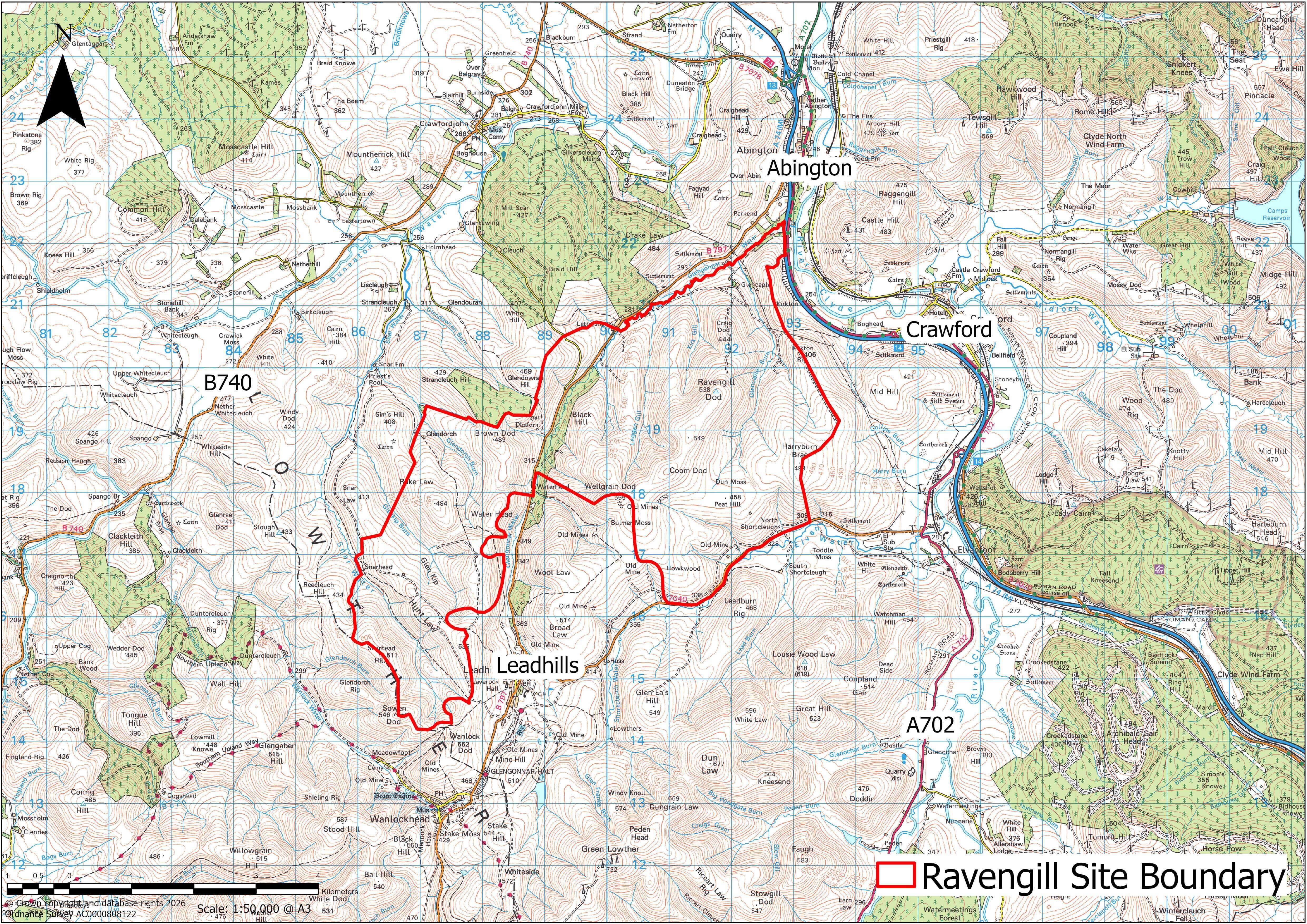
The Ravengill site extends over an area of approximately 2555 ha, west, north and east of Leadhills and approximately 1 km southwest of Abington, South Lanarkshire, Scotland.
Why here?
· The site is situated close to operational and proposed wind farm developments
· The site can accommodate a renewable energy development whilst avoiding significant direct effects on areas designated for nature conservation.
· The site has very good anticipated wind speeds.
· The site has very good access to the electricity transmission network.
· The site is located close to a concentration of infrastructure along the M74 corridor, providing access for both normal construction traffic and abnormal loads.
The Project
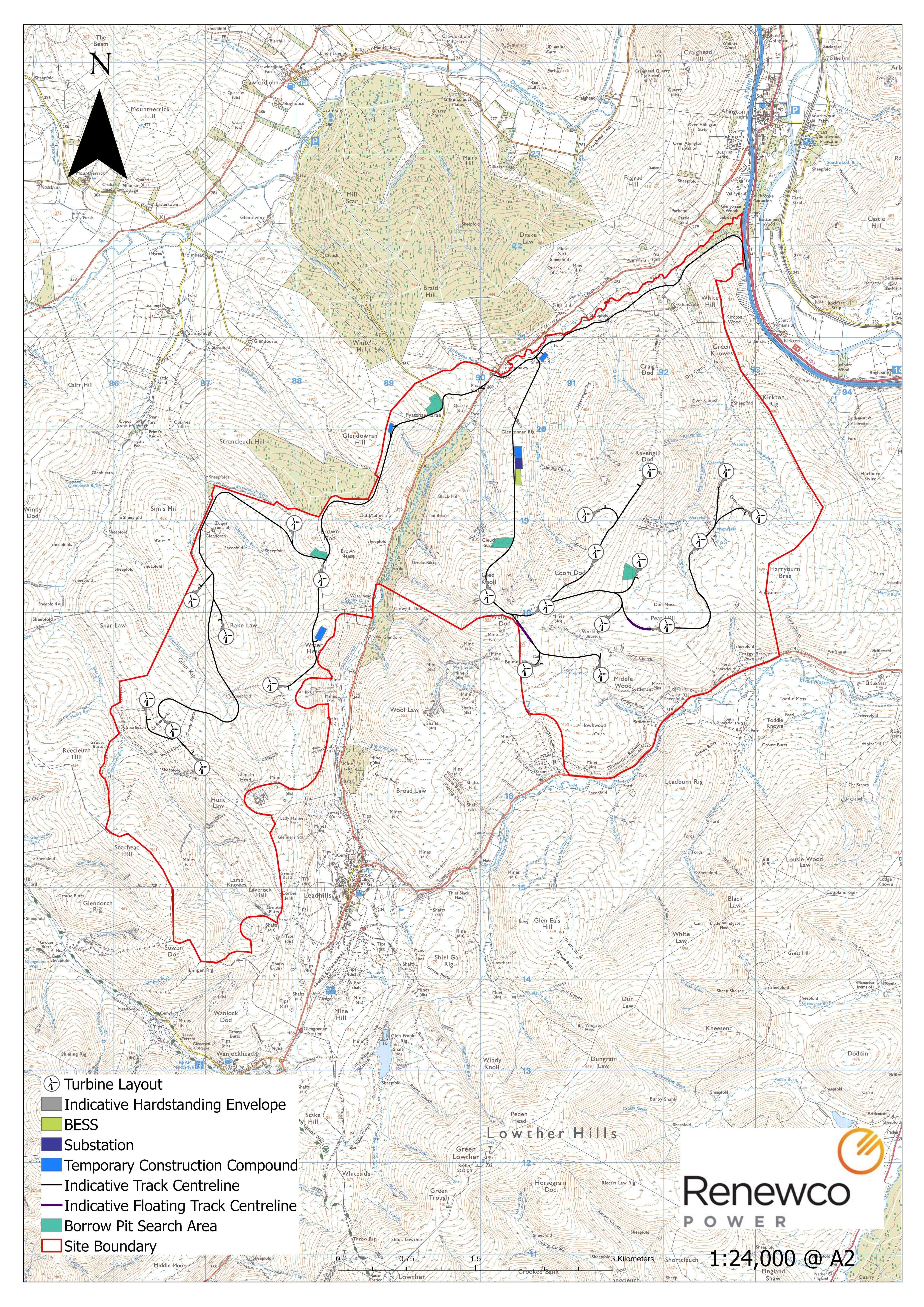
The project is at an advanced stage of development and is anticipated to include:
- up to 21 turbines (maximum tip height 220m)
- Battery Energy Storage System(BESS), approximately 50MW capacity
- onsite substation co-located with the BESS
- internal access tracks
- construction compound, laydown areas and borrow pits
- vehicular access from the A74(M) motorway for abnormal load deliveries (turbine components)
- construction and operational access from the B797, crossing the C class road that connects the B797 with Crawford John
Project development
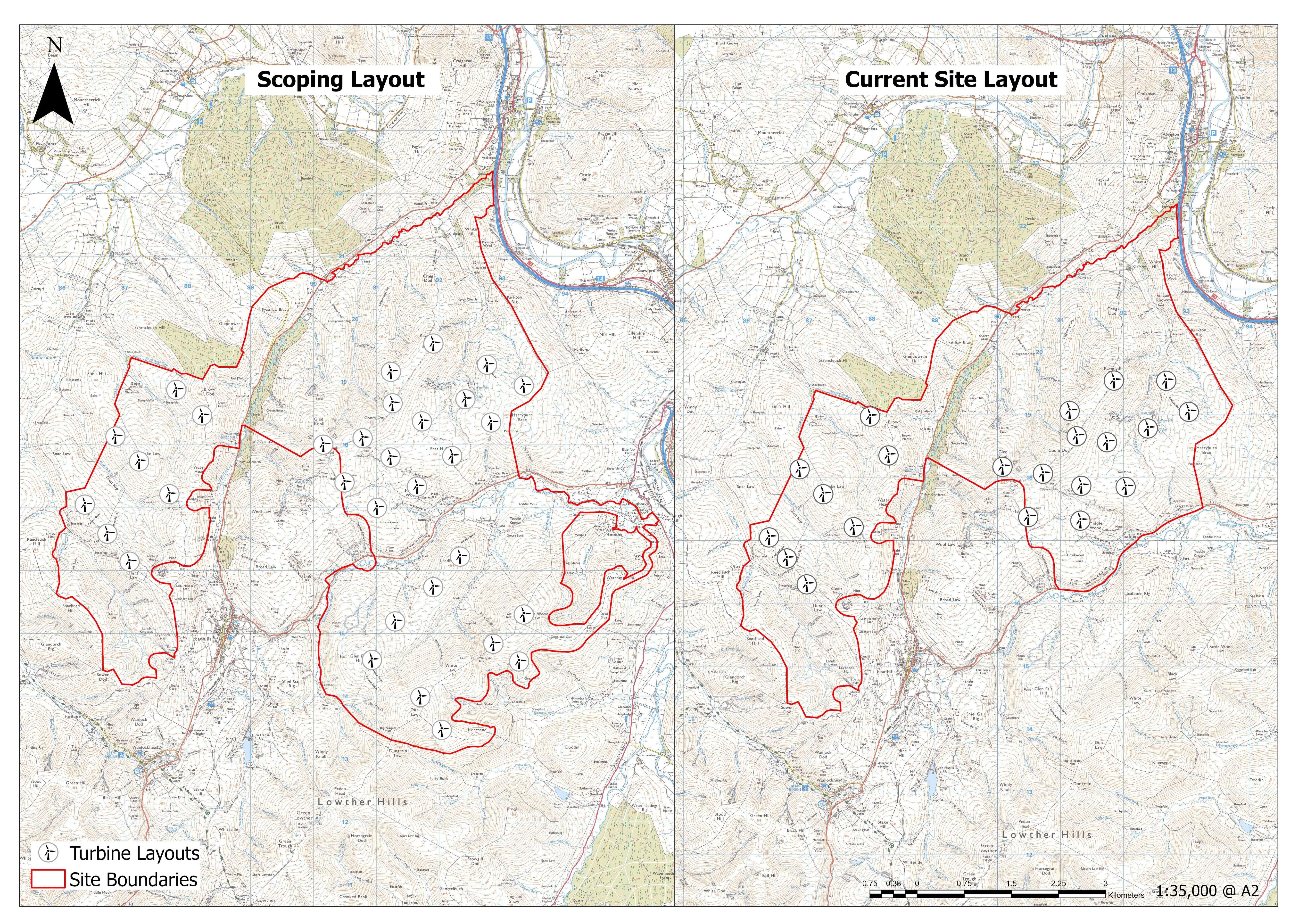
Since the consultation event in May 2025, the design of the project has been progressed based on:
Key issues raised include potential for impacts on: landscape and visual amenity, cultural heritage assets, ecological receptors, residential amenity and human health (noise, shadow flicker, and contamination), recreational use of the Site, and peat.
As a result of the issues raised the decision has been taken to remove the southern cluster of turbines (south of the B7040 Elvanfoot to Leadhills road) from the Proposed Development. Development north of the B7040 has also been drawn further back from the valley floor and road.
Public Consultation
The times, dates and locations of our second round of events are as follows:
10th February 2026 | Leadhills Village Hall (Ramsay Road, Leadhills, ML12 6YA) | 3pm to 8pm
11th February 2026 | Crawfordjohn Village Hall (Manse Road, CrawfordJohn, ML12 6SR) | 3pm to 8pm
The consultation banners presented at the events can be accessed here.
You can provide feedback on the project, including ideas on community benefits, via our AssetFace page.
Please provide feedback by the 25th of February 2026.
.
Visualisations
The visualisations presented at the consultation events on the 10th and 11th of February 2026 can be accessed below.
Please note that the images are not produced to Landscape Institute standards.
Indicative Development Timescale
9th May 2025
EIA Scoping Request submission
20-21 May
Public Consultation Exhibition 1
Q4 2025
EIA work and associated further studies
Q4 2025
Public Consultation Exhibition 2
Q1 2026
Submission of EIA and S36 application
Q1 2027
Consent Granted
Q1 2028
Discharge of planning conditions
TBC (2035 at the latest)*
Start of construction
TBC (2036 at the latest)*
Start of operation
40 years from start of operation (2076 latest)*
Start of decommissioning
41 years from start of operation (2077 at the latest)*
Target Submission Date for Planning Approval
* Under ongoing reforms to how entry of new connections to the national grid is managed, it is expected that the Ravengill Energy Park will be able to connect to the grid earlier than the 2036 date currently contracted.
Why is this project needed?
The Climate Change (Emissions Reduction Targets) (Scotland) Act 2019, which amends the Climate Change (Scotland) Act 2009, sets targets to reduce Scotland’s emissions of all greenhouse gases to net zero by 2045 at the latest. Significant additional renewable energy capacity, over and above what is produced today, will be needed to facilitate the decarbonisation of transport and heating as Scotland transitions to net zero.
The wind farm element of the Ravengill project will be sufficient to power approximately 178,110 homes[1] and will have a significant role in helping the Scottish and UK governments to meet their emissions reduction and net zero commitments. The BESS will also help balance electricity supply and demand on the National Grid.
[1] Calculated using RenewableUK’s methodology. Assumed capacity factor of 38.1% is taken from the Department for Energy Security and Net Zero’s (DESNZ) CFD Terms and Regulations Document. Average household consumption of 3.239 kWh is from DESNZ’s latest statistics.
Community Benefit
Ravengill Energy Park will provide a range of benefits for the local community, including a fund which will deliver direct investment into community projects and initiatives. The fund will reflect Scottish Government best practice guidance. For example, should the wind aspect of the development have an installed capacity of 147 MW, the Proposed Development would provide a minimum of £735,000 annually in community benefits.
You can submit your ideas about how the community could benefit from this funding via our AssetFace page. Please submit your ideas by the 25th of February 2026.
If you would like to get in touch with us in relation to Ravengill please email: ravengill@renewcopower.com.
Get in touch
We are interested in engaging with wind and solar asset owners, land-owners, developers and funders.